Do You Need to Know How to Code for Quantitative Trading? A New Answer in the AI Era
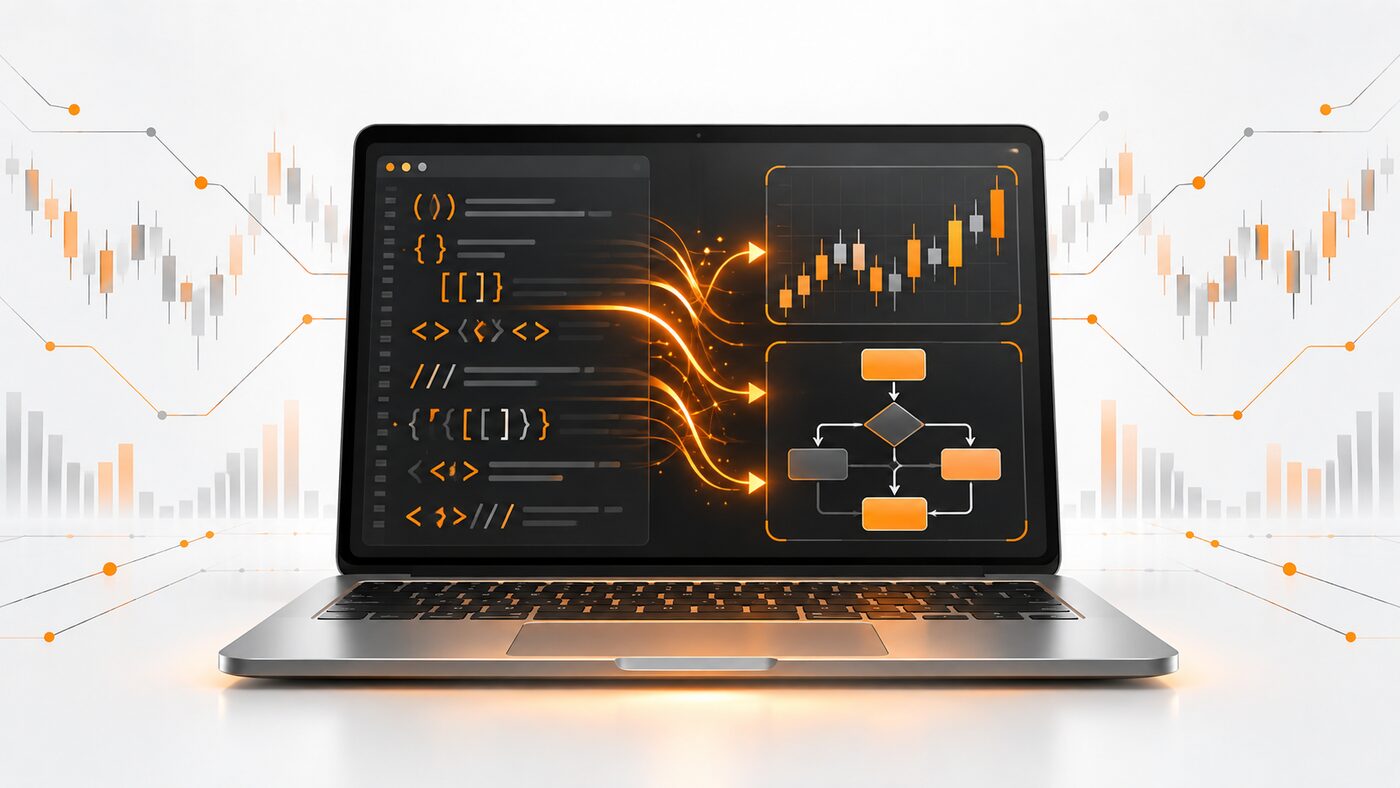
For years, almost everyone assumed the same thing: if you want to do quantitative trading, you first have to learn to code.
With AI and automation tools moving as fast as they are, that answer is changing.
Have you ever given up on quantitative trading just because you “can’t code”?
When most people first look into quantitative trading, this is what greets them:
MQL5
Python
APIs
GitHub
Docker
VPS
Backtesting
And then the doubt creeps in:
I just wanted to build my own trading system — why does this feel like switching careers to become an engineer?
So a lot of people get stuck right at step one.
They get scared off by the technical bar before they’ve even started thinking about strategy.
But here’s the real question:
Is quantitative trading really only for people who can code?
What actually makes up quantitative trading?
Code is just one of the tools involved.
What actually matters is:
What’s the logic behind your strategy?
How do you manage risk?
Are your entry and exit rules clearly defined?
Has your strategy actually been validated?
Without these, no matter how elegantly the code is written, that alone doesn’t make the strategy worth anything.
An engineer vs. a trader
Picture two people.
A: The engineer
Excellent at coding.
Can write:
Python
C++
MQL5
APIs
But doesn’t understand the market.
Doesn’t understand risk management.
Doesn’t understand trading logic.
B: The trader
Can’t code.
But knows:
What risk-to-reward ratio means
What trend trading means
What money management means
What strategy validation means
So which one is actually closer to succeeding at quantitative trading?
Usually, the answer is:
B can pick up the technical skills more easily than A can pick up trading.
The old answer: you pretty much had to learn to code
You’d need to learn:
Python — to handle data and run backtests.
MQL5 — to deploy the strategy to MT5.
APIs — to connect to your broker and market data.
VPS — to keep the strategy running 24 hours a day.
That’s exactly why, historically, the quantitative trading world was mostly made up of:
Engineers
People with a math background
People with a financial engineering background
Why do so many people study for six months and still haven’t started trading?
Because they’ve been learning tools this whole time.
…without ever finishing an actual strategy.
AI is changing how quantitative trading actually gets done
The biggest shift in recent years isn’t the market.
It’s the tools.
In the past:
Write the code yourself
↓
Debug it yourself
↓
Backtest it yourself
↓
Deploy it yourself
Now:
Describe what you need
↓
AI generates the strategy
↓
AI helps run the backtest
↓
AI helps with deployment
Traders are starting to spend more of their time on:
Strategy design
Risk management
Capital allocation
…instead of:
Debugging
Reading documentation
Fighting environment issues
How is AI changing the way quant strategies get built?
It can’t fully replace the work.
But it can dramatically lower the barrier to entry.
For example:
You used to need to know how to write:
if ma20 > ma60: buy()
Now you might just need to say:
Build me a moving-average crossover strategy — buy when the 20-day MA crosses above the 60-day MA.
And AI can help generate the strategy framework from there.
What does the quant trader of the future look like?
In the past:
Trader = trader + engineer
In the future:
Trader = strategy designer + AI collaborator
The focus is shifting from:
How do I write the code?
To:
How do I design the strategy?
Can you start quantitative trading without knowing how to code?
Yes, you can get started.
But it’s still worth understanding:
Basic trading knowledge, such as:
Risk management
Win rate
Risk-to-reward ratio
Drawdown
Basic quantitative concepts, such as:
Backtesting
Out-of-sample testing
Overfitting
Strategy stability
AI can write the code for you.
It can’t understand risk for you.
Quick check
Q1. What matters most in quantitative trading?
A. Writing the most impressive code
B. Building a verifiable trading system
C. Having the fastest computer
D. Using the most indicators
Q2. What’s AI’s biggest impact on quantitative trading?
A. Guaranteeing profit
B. Predicting the market
C. Lowering the technical barrier to entry
D. Replacing traders
Q3. Which skill is most worth prioritizing?
A. Risk management
B. Strategy design
C. Backtesting mindset
D. All of the above
Answers
Q1. ✅ B
Q2. ✅ C
Q3. ✅ D
Conclusion
The essence of quantitative trading has never been about writing code.
It’s about building a trading system that can be executed, validated, and improved on, again and again.
In the past, coding was the price of admission to quantitative trading.
Today, AI is letting far more people get past that barrier.
Going forward, the skill that actually holds value won’t necessarily be writing the most complex code.
It will be designing the most sound strategy — and understanding the risk and logic behind it.
Risk disclosure: CFDs are high-risk financial products that can lead to rapid loss of capital. Past performance does not guarantee future results. All strategies and backtests are for reference only and do not constitute investment advice. Please read our Risk Disclosure carefully before trading.
Further reading: your next step without writing a single line of code
If you want to go from the concept to building and deploying a real strategy, here’s a suggested order:
What Is Quantitative Trading? — start with the basics: rules, data, backtesting, and automation.
How Does AI Generate a Trading Strategy? — see how natural language turns into strategy conditions and a backtest workflow.
The MASQuant × MT5 Beginner’s Guide — deploy your generated strategy to MT5 and put it into action.