What Is 100:1 Leverage? It Does Not Make You 100x More Money, It Lets You Carry More
100:1 leverage is one of the most misunderstood terms in trading. “100x leverage” sounds like a magic button that multiplies your profit by a hundred.
It is not.
This article explains what leverage actually changes, why margin is so often misread as “the most you can lose,” and why that misunderstanding is dangerous.
The Short Version
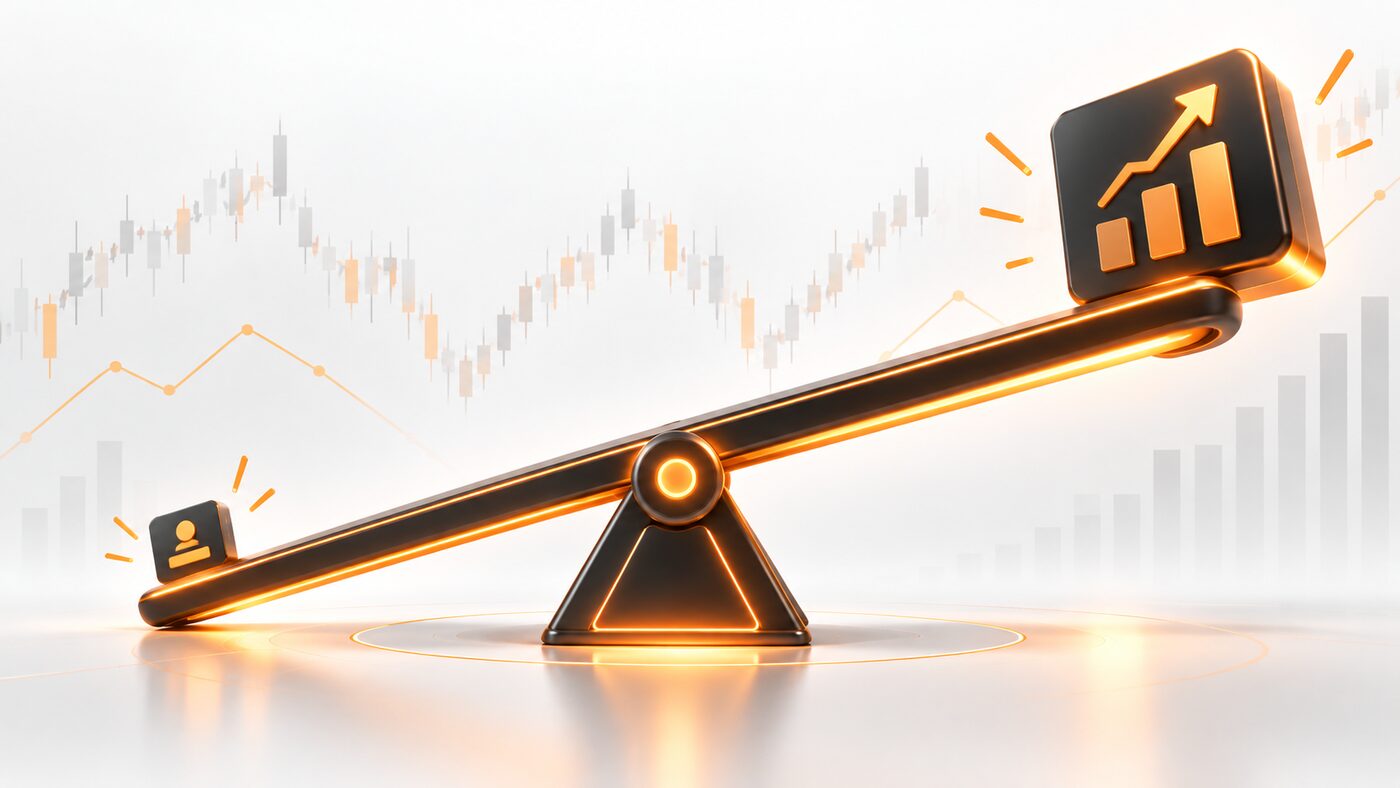
Leverage only changes how much money you need to put up. It does not change how much you are carrying.
The real risk is that the barrier to entry drops, making it easier to take on a position bigger than you can actually handle.
Something You Already Understand: Buying a House
Let us start with something that has nothing to do with trading, but that you already understand.
A 20% down payment of $200,000 buys a $1,000,000 house.
The $200,000 is your money. The remaining $800,000 is borrowed from the bank — a mortgage.
When the house rises or falls in value, the move is calculated on the full $1,000,000 price, not on the $200,000 you put in. So:
House drops 20% → market value is now $800,000 → mortgage still owes $800,000 → your equity = 800,000 − 800,000 = 0A 20% drop wipes out your entire down payment. It is not proportional to the percentage you put in — it is the exact point where the mortgage balance catches up with the market value.
Mapping This to Leverage Trading
Leverage works the same way, just with different names:
| House | Leveraged Trade | |
|---|---|---|
| Your money | Down payment $200k (20%) | Margin |
| What covers the rest | Mortgage $800k | Leverage |
| The whole thing | House price $1,000k | Position |
Here is a simple example (a round number used for illustration, not live market data): a $20,000 position at 100:1 leverage only requires a margin of:
$20,000 ÷ 100 = $200You put up $200, but you are carrying $20,000. The gap in between is what the leverage is covering — just like the mortgage covers that $800,000 in the house example.
So Is $200 the Most I Can Lose?
No. This is the single most important sentence in this article.
Margin is not a stop-loss. It is simply a deposit that gets locked up.
Your loss is deducted from your entire account equity, not just from that one margin deposit. Whatever else is in your account can be eaten into by the same trade.
Here is the math:
Position $20,000, moves 1% against you = a $200 lossThat $200 happens to equal the entire margin for this trade. A 1% adverse move wipes out 100% of the margin — and if your account equity is more than $200, the loss does not stop there; it keeps being deducted from the rest of your account.
So Can I End Up Owing Money?
Most regulated retail brokers today (mandated by the EU’s ESMA, the UK’s FCA, and Australia’s ASIC) provide negative balance protection, which prevents your account balance from going negative.
But to be precise: negative balance protection covers your entire account, not that one margin deposit. It stops you from owing the broker money — it does not mean this particular trade’s loss is capped at the margin figure. These are two different things, and they get mixed up constantly.
The Leverage Ratio Changes the Barrier, Not the Exposure
Change the leverage ratio on the same position, and the margin changes — but the position size and the profit/loss do not:
| 100:1 | 20:1 | |
|---|---|---|
| Position | $20,000 | $20,000 |
| Margin | $200 | $1,000 |
| Loss on a 1% adverse move | $200 | $200 |
| That loss as a share of margin | 100% | 20% (1/5) |
Same 1% move, same $200 loss on both sides — the position size has not changed, and neither has the profit/loss. The only difference: at 100:1, that $200 wipes out the entire margin; at 20:1, it only eats a fifth of it.
What the leverage ratio changes is how much money you need to put up to open this position, not how risky the position itself is.
Where the Real Risk Actually Comes From
Leverage by itself is not a matter of dangerous or safe. What it changes is the barrier to entry: the same amount of capital can open a much bigger position at high leverage than at low leverage.
The risk does not come from the leverage ratio itself — it comes from the barrier being lower, which makes it easier for you to unknowingly take on a position bigger than you can actually handle. On a $20,000 position, whether your margin is $200 or $1,000, a 1% adverse move still costs you $200 either way. What determines whether you can stomach that is the size of the position, not the leverage ratio number.
Frequently Asked Questions
What does 100:1 leverage mean?
It means you only need 1/100th of the position value as margin to open that position. For example, a $20,000 position at 100:1 leverage requires $200 in margin. Leverage changes how much capital you need to put up, not the size or riskiness of the position itself.
Is margin the most I can possibly lose?
No. Margin is just the deposit locked up to open a position, not a cap on your loss. Your loss is deducted from your entire account equity, and whatever else is in your account can be eaten into by the same trade.
What does negative balance protection actually protect?
Negative balance protection keeps your overall account balance from going negative (so you cannot end up owing your broker money), but it does not mean any single trade’s loss is capped at that trade’s margin amount. These are two separate concepts.
Does higher leverage mean higher risk?
Not exactly. What determines the size of the risk is how big the position itself is, not the leverage ratio number. But higher leverage does lower the barrier to entry, making it easier to end up carrying a bigger position with the same amount of capital — that is where the risk comes from, not the ratio itself.
Does the same position produce different profit or loss under different leverage?
No. Position size is what determines profit and loss; the leverage ratio only determines how much margin you need to put up. Change the leverage on the same position and the profit/loss stays exactly the same — only the margin required changes.
Conclusion
The most commonly misunderstood idea in leveraged trading is treating margin as a loss cap.
Margin determines whether you can open the position. What actually determines how much you can lose is the size of the position and how the market moves — and the leverage ratio has no say in either of those.
What leverage amplifies is how much you can carry, not how much you can earn.
This article is part of the MASQuant Trading Basics series, walking you through the fundamentals of trading one concept at a time.
Risk Disclosure: CFDs are high-risk financial instruments that can result in the rapid loss of money. Past performance does not guarantee future results, and all strategies and backtests are for reference only and do not constitute investment advice. Actual margin ratios, leverage limits, and margin call/liquidation rules vary by broker, instrument, and account type. Please fully understand our Risk Disclosure before trading.
Further reading: How Much Is 1 Lot? Shares, Contracts, and Lots – What Does the “1” in Your Order Box Actually Mean?