What Is the Spread? Why Your Trade Is Negative the Moment You Buy
You’ve just clicked Buy, and your floating P&L is already negative.
The price has barely moved. Did you buy wrong?
You didn’t buy wrong. It’s the spread.
This is part five of MASQuant’s “Trading Academy · Beginner Essentials” series. The first four parts covered what to calculate before you place an order: what one lot is, how to calculate lot size, leverage, and where to put your stop loss. This one covers a cost that has already happened the moment you click submit.
The short answer
Being negative the moment you enter is normal — that’s the spread, not a bad entry.
Before you trade, take a look at the spread and compare it with your stop loss and target.
Every quote actually has two prices
A quote in your trading platform actually shows two prices at once:
| Price | Term | When it’s used |
|---|---|---|
| Buy price | Ask | You buy at this price (the higher one) |
| Sell price | Bid | You sell at this price (the lower one) |
The gap between these two prices is called the spread.
A simple example (round numbers for illustration, not market data):
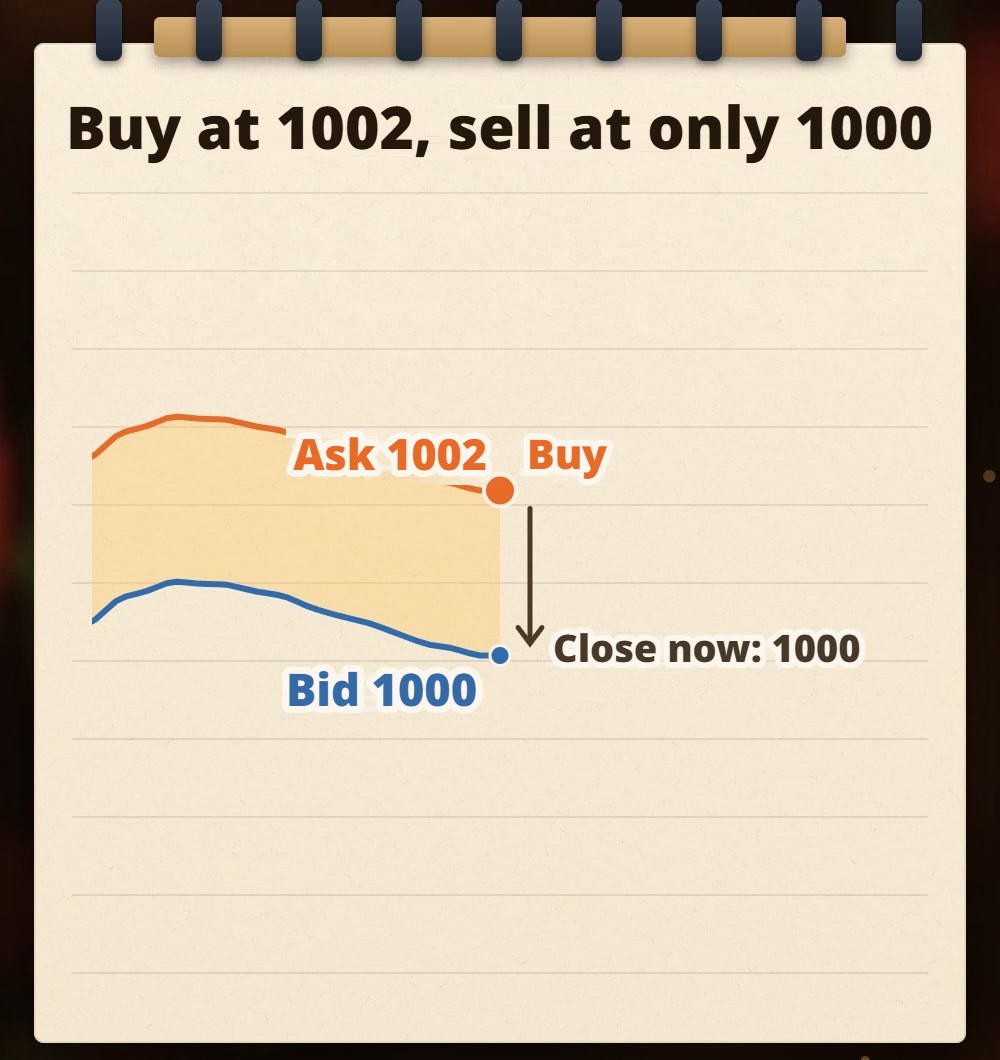
Ask 1002
Bid 1000
Spread = 1002 − 1000 = 2 points
How much price movement “one point” represents differs by instrument; we’ll cover how to check that later. For now, round numbers make the idea clear.
Don’t mix up the names
“Buy price” and “sell price” here are from your point of view as the one placing the order: you buy at the buy price and sell at the sell price.
If you’re used to stock quotes, note this: in an order book, the “bid” is the price someone else has posted to buy at — if you want to sell immediately, that’s the price you actually get. The same price is a “buy” from the side of the person who posted it, and a “sell” from yours.
Platforms and languages label these differently, so the safest way is to remember the English terms: Ask is the price you buy at; Bid is the price you sell at.
Why you’re negative the moment you enter
Long trades: enter at the ask, close at the bid
You buy at the ask of 1002. If you close immediately, you’re “selling”, so you can only sell at the bid of 1000:
Buy (at the ask): 1002
Close immediately (at the bid): 1000
P&L: 1000 − 1002 = −2 points
That’s why platforms usually calculate a long trade’s floating P&L using the current bid — the price you can actually close at right now. Even if the price hasn’t moved at all, you’re already 2 points down.
To break even, the bid has to rise back to your entry price of 1002; if the spread stays the same, the whole quote has to move up 2 points first. Price has to rise past those two points before you start making money.
Short trades: exactly the opposite
Going short means selling first, so you enter at the bid of 1000; to close, you buy back at the ask of 1002. You also start at −2 points, and only break even once the ask falls back to 1000.
| Enter at | Close at | Floating P&L based on | |
|---|---|---|---|
| Long (buy first) | Ask | Bid | Bid |
| Short (sell first) | Bid | Ask | Ask |
This is a cost you pay on every trade, whether it ends in profit or loss.
The spread is one trading cost, but not the only one
The spread doesn’t appear as a separate charge on your statement; it’s built into the prices at which you enter and exit. Two other common trading costs work differently:
| Cost | When it’s incurred | How it’s calculated |
|---|---|---|
| Spread | On every trade, the moment you enter | The gap between ask and bid, built into the fill price |
| Commission | Charged separately on some account types only | Usually per lot traded or by trade value |
| Overnight swap | When a position crosses the platform’s daily settlement time | Depends on the instrument, direction and days held; can be a charge or a credit |
Whether and how these are charged depends on the platform, instrument and account type. Compare all three together — no commission doesn’t mean no trading cost; the spread is still there.
Also, slippage is not the spread. Slippage is when your actual fill price differs from the price when you placed the order, which is common when the market moves fast. It can also raise your costs, but it’s a separate issue.
The spread isn’t fixed
Two points is just an example. Real spreads change with the market, and they commonly widen:
- Around major data releases: such as rate decisions or jobs data. The market is uncertain, fewer participants quote nearby prices, the bid and ask are easily pulled apart, and the spread can suddenly widen several times over.
- During quiet trading hours: with fewer participants and fewer orders, the distance between bid and ask naturally grows.
- Near the open and close: just after an instrument opens, near its close, around the daily rollover, and when markets reopen after the weekend, quotes are often less stable.
A wider spread also affects trades you already hold: if the bid is pulled down, long trades’ floating P&L gets worse; if the ask is pushed up, short trades get worse. A trade with a stop close by can be stopped out this way.
Fixed vs. floating spreads
Account spreads generally come in two types:
- Floating spread: changes with market quotes and can widen a lot around data releases or during quiet hours.
- Fixed spread: the platform sets a number in advance that normally doesn’t change with the market. But “fixed” doesn’t mean it never changes — how extreme markets are handled depends on the platform’s terms.
Which type your account uses is shown in the instrument specification (how to check in MT5 is below).
The spread eats your stop: what happens with a 5-point stop
The previous part, How to Set a Stop Loss?, explained that your stop distance should be larger than the price’s normal fluctuation, or you’ll get shaken out. Here’s one more thing: the spread also eats into your stop.
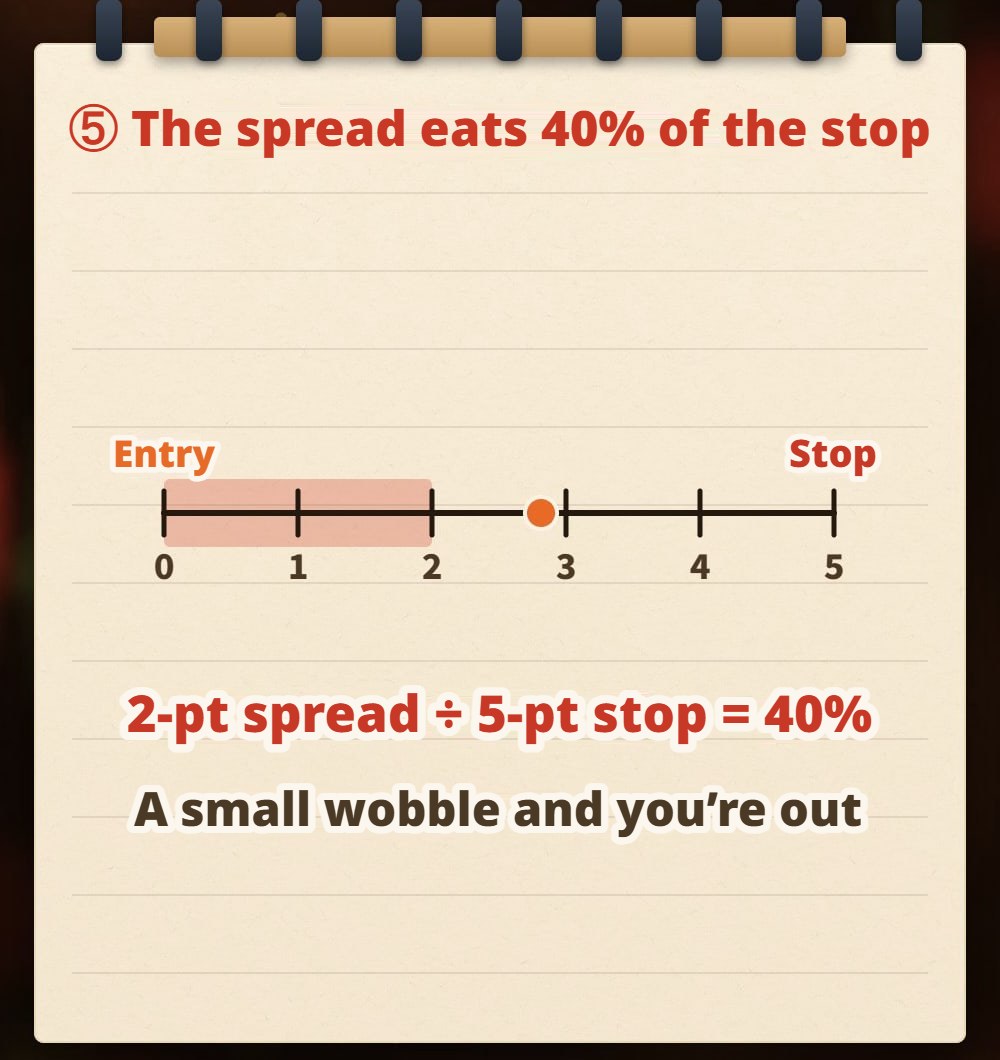
Continuing the same example: you buy at the ask of 1002 and set a 5-point stop, at 997.
In MT5, stop losses and take profits on long trades are triggered by the bid. The bid is now 1000, just 3 points from 997:
Entry (ask): 1002
Stop loss: 997 (5 points from entry)
Current bid: 1000 → only 3 points from the stop
Of that 5-point stop, 2 points were used up the moment you clicked Buy — the spread alone ate 40% of your stop. A light 3-point wobble and you’re out.
The smaller the stop, the bigger the spread’s share (round numbers for illustration, spread always 2 points):
| Stop distance | Spread as share of stop | Room left for the bid to fall |
|---|---|---|
| 5 points | 40% | 3 points |
| 20 points | 10% | 18 points |
| 50 points | 4% | 48 points |
The same goes for targets. With a take profit 10 points above entry (1012), also triggered by the bid, the bid has to go from 1000 to 1012: the market has to move 12 points for you to gain 10.
The spread makes winning and losing asymmetric: to lose 5 points, price only needs to move 3 points against you; to gain 10 points, it needs to move 12 points in your favor.
There’s no standard answer to how big a share is too big; it depends on how you trade. What matters is comparing before you trade, not finding out after you exit.
Watch out on short trades: the chart never touched it, but your stop was hit
In MT5, the candles for most forex and CFD instruments are drawn using the bid. But short trades close at the ask, and their stops are triggered by the ask.
So when the spread suddenly widens, this can happen: the candles on the chart are still some distance from your stop, but the ask has already touched it, and your short is stopped out. To see the ask on your chart, turn on the Ask price line (see the next section).
The more often you trade, the more spread you pay
You pay the spread once per trade (one entry and one exit). Trade in and out 10 times a day, and you pay it 10 times (round numbers for illustration):
2 points each × 10 trades = 20 pointsYou pay those 20 points whether you’re right or wrong. In money terms:
Spread cost = spread (points) × value per point × lotsWe broke down how much one point is worth in part two, How to Calculate Lot Size? (there we called it the “value per tick”). The more lots you trade, the more money the same spread costs.
The more often you trade, and the smaller your stops and targets, the bigger the spread’s share. That doesn’t mean short-term trading can’t work — just that you can’t leave the spread out of your cost calculations.
Check the spread in MT5 before you trade
- Open Market Watch (shortcut Ctrl+M): every instrument shows two prices, Bid and Ask.
- Add the spread column: right-click in Market Watch and tick Spread under Columns to add a spread column.
- Check the specification: from the same right-click menu, choose Specification to see whether the spread is floating or a fixed number, and how the overnight swap is calculated.
- Show the ask on the chart: in chart properties (F8), on the Show tab, tick Show Ask price line to add an ask line to the chart.
Note the unit of the Spread column: it’s the instrument’s smallest price increment (point), which isn’t necessarily what you’d call a “point”. For example, the 1 pip commonly used in forex equals 10 points on currency pairs quoted to five decimal places. How “one point” works for gold, indices and similar instruments varies by platform — just as part one, How Much Is 1 Lot?, said: check the instrument specification first.
Once you see the number, compare it with your stop loss and target.
Common mistakes
1. Seeing a negative number right after entry, assuming you bought wrong, and rushing to close
The initial negative is the spread, not the market turning against you. Closing now just locks in the spread as a cost. Whether to keep the trade depends on whether your reason for entering still holds, not on the minus sign you saw at the start.
2. Trading as usual around data releases without checking the current spread
Your stop distance was planned for a normal spread; if the spread suddenly widens several times over, your original stop may no longer be enough.
FAQ
What is the spread?
Every quote has two prices: the ask, which you buy at, and the bid, which you sell at. The ask is higher than the bid, and the gap between them is the spread. It’s a cost you pay on every trade, incurred the moment you enter.
Why is my trade negative as soon as I buy?
A long trade enters at the ask but has to close at the lower bid, and platforms usually calculate floating P&L using the current bid. So even if the price hasn’t moved at all, you start one spread down. Short trades are the reverse — enter at the bid, close at the ask — and also start negative.
Is the spread charged once on entry and again on exit?
No. If the spread is the same at entry and exit, one round trip costs one spread: a long enters at the ask and exits at the bid, and the difference over that full round trip is the spread. Your trade shows negative right after entry because the platform has already calculated it at “the price you’d get if you closed now”. If the spread is wider when you exit, the trade’s cost rises accordingly.
How is the spread different from commission and the overnight swap?
The spread is built into the bid and ask and applies to every trade; commission is a separate fee on some account types, usually by lots or trade value; the overnight swap only applies to positions held overnight and, depending on the instrument and direction, can be a charge or a credit. Actual charges vary by platform, instrument and account type.
Why does the spread suddenly widen?
Commonly around major economic data releases, during quiet trading hours, and around the open, close and daily rollover. At these times the market is uncertain and fewer prices are quoted, so the bid and ask are easily pulled apart and the spread can suddenly widen several times over.
How do I check the spread in MT5?
Open Market Watch (Ctrl+M): each instrument shows its Bid and Ask. Right-click and tick Spread under Columns to see the spread directly. The unit of this column is the instrument’s smallest price increment (point), which isn’t necessarily the “point” you’re used to.
Final thoughts
Part one said check the specifications first, part two said calculate your lot size first, part three said margin is not a stop loss, and part four said put your stop where you’d be proven wrong. This part covers what happens the moment you click submit: the spread.
It’s a cost you pay on every trade. Being negative right after entry is normal; what to watch is how much of your stop and target it takes, and how many times a day you pay it.
Being negative right after entry is normal; when the spread is too wide to be worth it, not entering is also a choice.
Risk disclosure: CFDs are high-risk financial products and can lead to rapid loss of capital. Past performance does not guarantee future results. All strategies and backtests are for reference only and do not constitute investment advice. Actual spreads, commissions and overnight swaps vary by platform, instrument and account type, and change with market conditions. Please read our Risk Disclosure carefully before trading.
Further reading:
- How Much Is 1 Lot? What the “1” in Your Order Box Actually Means
- How to Calculate Lot Size? With the Same $10,000, Gold and EUR/USD Can Differ by 6.7x
- What Is 100:1 Leverage? It Does Not Make You 100x More Money, It Lets You Carry More
- How to Set a Stop Loss? It Is Not How Much You Can Lose, It Is Where You Are Wrong
- What Is an Overnight Swap? Why Your Balance Changes Even When You Did Nothing